MoonlightTaghazout
- Wind
- UV, clear sky
- Rain, next hour
- Humidity
- Sunrise
- Sunset



WEATHER · LIVE AND CLIMATE
The weather right now at our two houses, the next 24 hours and the week ahead, the sea and the wetsuit it calls for, and what each month brings. Every figure carries its source.
THE FORECAST
MET Norway’s forecast for each house’s own coordinates: every hour for the first two and a half days, then every six hours. Temperatures in °C, rounded to the degree; the shaded hours are the night, from sunset to sunrise. Rain in mm over the hour, or added up over the day. Wind in km/h (MET Norway gives m/s): the arrow points where the wind blows, the letters say where it comes from; for the week, the strongest wind of the day’s forecast steps. UV: the clear-sky index, which clouds lower; for the week, the day’s highest, given for the first two and a half days only. MET Norway forecasts no gusts and no chance of rain for Morocco, so we show none. Every time is local time (Morocco, GMT).
The live wind map, on WindyTHE SEA
The reading is the surface of the sea in the 5 km satellite cell off Taghazout, once a day; the date is the day it describes. When strong north winds blow in summer, colder water rising from below can cool the sea by 2 to 3 °C for a few days.
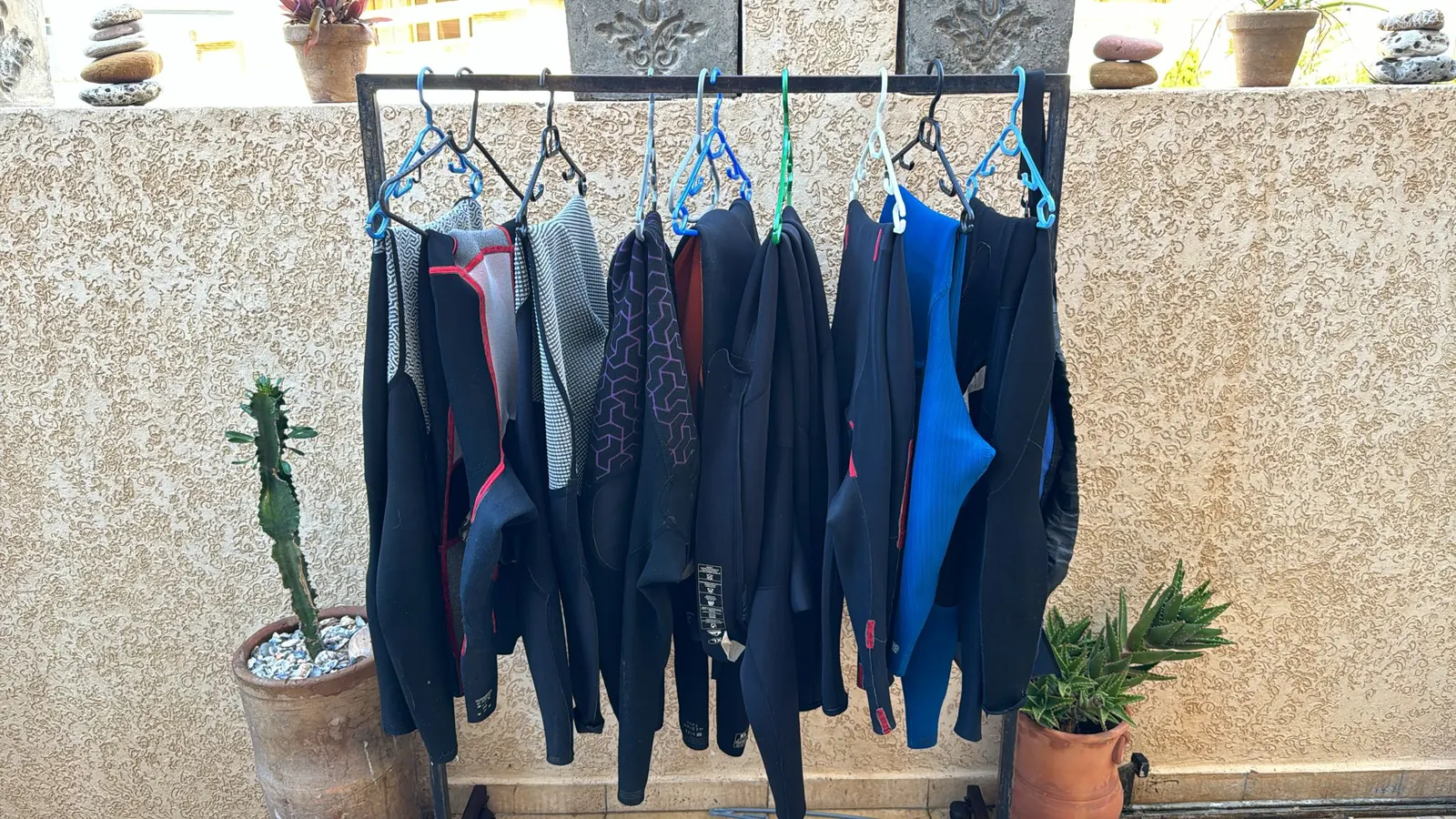
The waves today: the surf report2 mm spring suit or long-sleeve shortyToday
July to October; a 3/2 when the wind is up or the water turns cold for a few days. Boardshorts alone are almost never enough here.
3/2 full suitToday
May, June and November. On a cold winter morning, take the 4/3.
4/3 full suitToday
Or a 3/2 with boots if you run warm. The winter suit, December to April.
4/3 with bootsToday
Rare here: the sea seldom drops under 16 °C, even in February.
On a cold morning, under 13 °C in the air at dawn, take one suit warmer: a 4/3 instead of a 3/2.
Wetsuits: the Rip Curl and Quiksilver thickness charts, read for this coast.
THE CLIMATE
Averages, not a forecast: what an ordinary month brings to Taghazout and Tamraght. The current month is marked.
| Month | Air, low to high°C | Sea°C | Rainmm | Rainy days1 mm or more | Sunshinehours a day | UVdaily high | Sunrise · sunsetthe 15th, local time | Wetsuit |
|---|---|---|---|---|---|---|---|---|
| JanuaryNow | 10 to 20.5 °C1020.5 | 18 | 32 | 2.8 | 7.4 | 4 | 07:36 and 17:59 | 4/3 |
| FebruaryNow | 11.5 to 21.5 °C11.521.5 | 17 | 29 | 2.7 | 7.6 | 5 | 07:19 and 18:26 | 4/3 |
| MarchNow | 13 to 22.5 °C1322.5 | 17 | 31 | 3.2 | 8.2 | 7 | 06:49 and 18:46 | 4/3 |
| AprilNow | 14 to 22.5 °C1422.5 | 18 | 14 | 1.7 | 8.9 | 8 | 06:11 and 19:06 | 4/3 |
| MayNow | 16 to 23.5 °C1623.5 | 18.5 | 6 | 0.8 | 9.4 | 9 | 05:44 and 19:26 | 3/2 |
| JuneNow | 17.5 to 25 °C17.525 | 19 | 1 | 0.2 | 8.7 | 10 | 05:36 and 19:42 | 3/2 |
| JulyNow | 19 to 26 °C1926 | 20 | 0 | 0.1 | 7.9 | 10 | 05:46 and 19:42 | 2 mm |
| AugustNow | 19 to 26.5 °C1926.5 | 20.5 | 3 | 0.3 | 8.1 | 9 | 06:05 and 19:21 | 2 mm |
| SeptemberNow | 18.5 to 25.5 °C18.525.5 | 20.5 | 4 | 0.5 | 7.5 | 8 | 06:23 and 18:44 | 2 mm |
| OctoberNow | 17 to 25 °C1725 | 20.5 | 21 | 1.9 | 7.7 | 6 | 06:40 and 18:07 | 2 mm |
| NovemberNow | 14 to 23 °C1423 | 19 | 42 | 3 | 7.3 | 4 | 07:04 and 17:41 | 3/2 |
| DecemberNow | 11.5 to 21.5 °C11.521.5 | 18.5 | 49 | 3.6 | 7.4 | 3 | 07:28 and 17:39 | 4/3 |
| The year | 15.1 to 23.6 °C15.123.6 | 18.9 | 232 | 20.8 | 8.0 | – | – | – |
Air: the average low of the night and high of the day. Rainy days: days with at least 1 mm. Sunshine: hours of bright sun a day, 2,924 hours in the year. UV: the average daily high. Sunrise and sunset at Moonlight on the 15th of the month, local time; Tamraght is within a minute. The year: the means of the months, the rain and the rainy days added up.
December to FebruaryNow
Sunny days of 20.5 to 21.5 °C and nights of 10 to 11.5 °C, with about three rainy days a month. The prime surf season: long north-west swells, offshore mornings, the points working most days.
PackA warm layer for the evenings, a windproof jacket, a light rain shell, sunglasses, a 4/3.
March to MayNow
Highs of 22.5 to 23.5 °C, windy afternoons and a few hot chergui days, most of them in March. The surf is still good in March and April and softens in May: surf the mornings.
PackLayers, a windbreaker, SPF 50 (UV 7 to 9), a 4/3 until April, a 3/2 in May.
June to AugustNow
Highs of 25 to 26.5 °C, almost no rain, grey sea-mist mornings that usually clear by late morning, breezy afternoons. Small, friendly beach-break waves: the easiest months to start.
PackLight clothes and a sweatshirt for the mornings and evenings, a hat, SPF 50 (UV 9 to 10), a 3/2 in June, a spring suit in July and August.
September to NovemberNow
The warmest sea of the year, 20.5 °C from August to October, the most chergui days in October, and the season’s first north-west swells. The rain comes back in October and November.
PackSummer clothes and a light sweater, a rain shell in November, a spring suit in September and October, a 3/2 in November.
The chergui is a hot, dry wind from the Sahara that comes down off the Atlas. Here it blows offshore, so the waves are clean while the air heats up. The Agadir station counts about 30 days a year over 30 °C, nearly all of them chergui days: 5.3 a month in October, 4.3 in August, 3.9 in March, almost none in December and January. Desert dust, the calima, hazes the sky most in July and August, on 8 to 10 days a month in 2023–2025; near the ground it is felt most from February to April.
From July to September, about one morning in three starts grey: low cloud and mist come in from the sea at night and usually burn off by late morning. Mist or fog shows on 2.5 to 6 mornings a month all year, most often from July to October, then in February and March. These counts come from Agadir airport, 20 km inland; the coast itself probably sees a few more grey mornings.
SOURCES
Waves: NOAA WaveWatch III via PacIOOS. Weather and wind: Data from MET Norway (CC BY 4.0). Sea temperature: NOAA Coral Reef Watch. Tide and sun: computed for Taghazout.
Forecasts are models: our coaches decide on the day.
YOUR STAY
Pick the house, the nights, the surf and the days out in the builder; the price follows every choice. Our team confirms everything before you pay.
Build my stayThe photographs are ours, taken from the two houses and on the road.